 Around 250 km²
Guides
Language
EnglishCurrency
US dollar · $Prices on GetYourGuide appear in your chosen currency.
Guide · The science
Is the Perito Moreno glacier growing, or is it melting?
For decades it was the glacier that did not retreat. New research tells a different story. Here is what is known about its size, its past and the changes measured since 2019.
Check availabilityfrom $69 · free cancellation
Editorial team, perito-moreno-glacier-tours.comUpdated October 16, 2026Read time: 7 min16 sources
Short answer
- 01Growing?
- No: researchers report thinning and retreat since 2019.1
- 02Before
- Until recently the front moved back and forth about 50 meters a year.1
- 03Now
- Near the tongue it thinned 5.5 to 6.5 meters a year from 2019 to 2024.2
- 04Retreat
- In places the tongue has pulled back more than 800 meters.3
- 05Size
- The glacier covers around 250 square kilometers.4
The glacier that seemed to resist
Ask whether the Perito Moreno glacier is growing and you may hear a confident yes from older guidebooks. For a long time it had that reputation. While other ice masses in Patagonia shrank, this one held its position, and researchers describe how it fluctuated back and forth by about 50 meters each year until recently.1 Stability in a warming world made it famous, and the steady calving at its front drew visitors from everywhere.
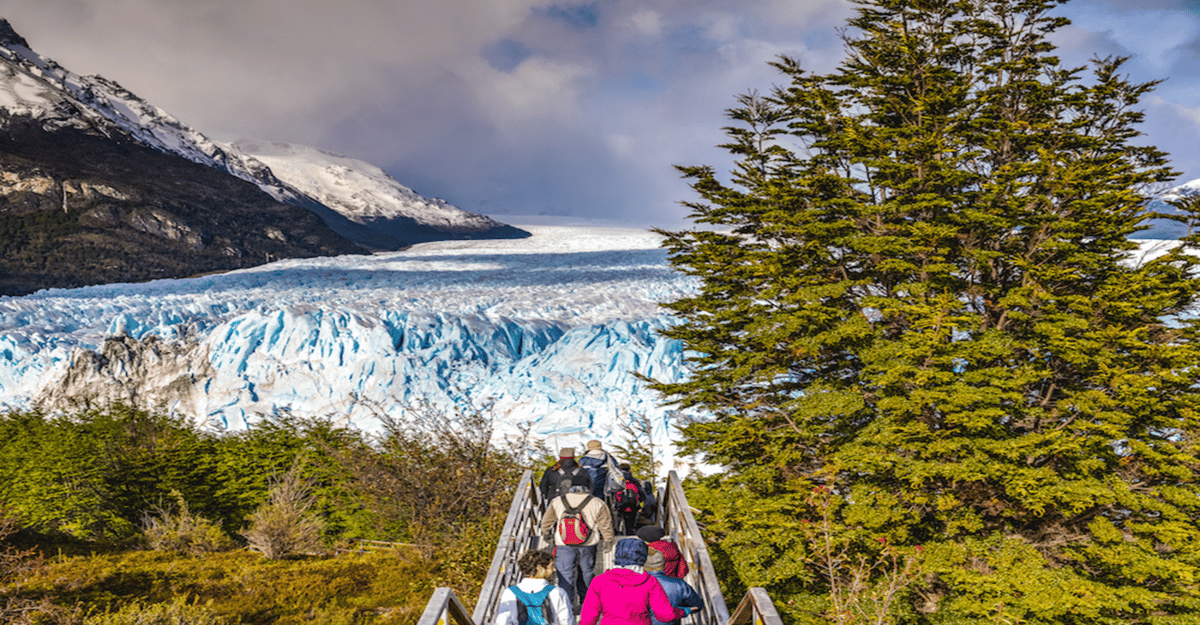
That reputation was based on real observations, but it described a balance rather than growth. A glacier gains ice from snowfall high in the mountains and loses ice at its front and surface. For many decades those gains and losses roughly matched at the Perito Moreno. The front advanced a little, broke off, advanced again, and the overall picture from the walkways looked unchanged year after year.
Researchers now report that this balance has broken. The situation has changed dramatically since 2019, according to the glaciology group at the University of Erlangen-Nürnberg.1 The answer to the question is no: the glacier is not growing, and the recent measurements show it losing ice at about 16 times the earlier rate near its tongue.2 That makes this a good moment to visit with fresh eyes, knowing what the scientists have measured, rather than with the old idea of a glacier that never changes.
History
The Perito Moreno glacier through time
-
Park founded
Protection begins
Los Glaciares National Park was created in 1937.5
-
Ice dams
Brazo Rico blocked
Periodic advances from 1940 onward blocked the side arm.6
-
World Heritage
UNESCO listing
The park was declared World Heritage in 1981.5
-
Slow thinning
A stable glacier
About 34 centimeters a year from 2000 to 2019.2
-
The turning point
Rapid thinning
5.5 to 6.5 meters a year from 2019 to 2024.2
Is the Perito Moreno glacier melting?
Yes, and the pace has picked up. The researchers report that from 2000 to 2019 the glacier lost about 34 centimeters of thickness per year, a slow rate.2 After that, the lowering of the surface near the glacier tongue accelerated to about 16 times the earlier rate, reaching 5.5 to 6.5 meters per year between 2019 and 2024.2 Each year the ice near the front lost a thickness comparable to the height of a house.
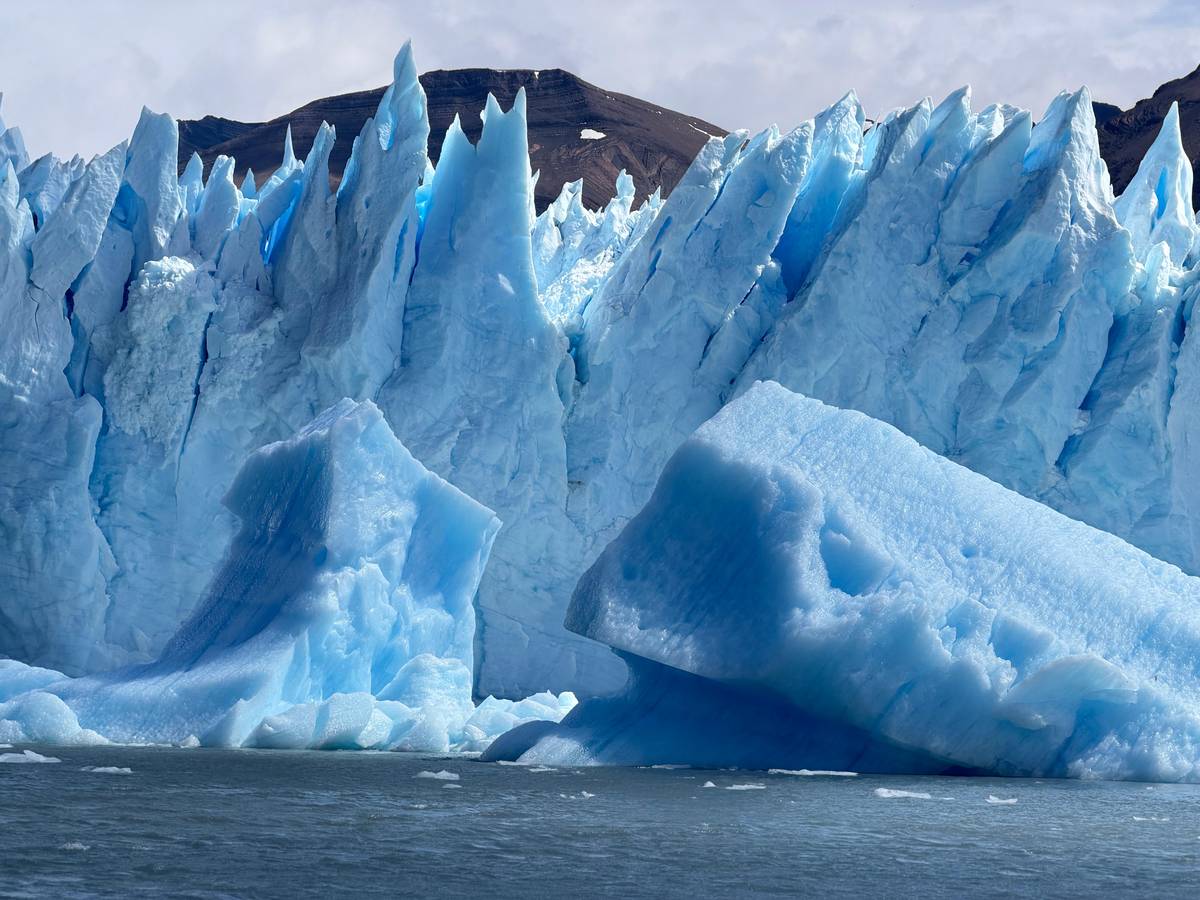
The glacier is also getting shorter. In some places, the tongue has retreated more than 800 meters, according to the same study.3 For visitors this can be hard to see at first, since the front still looks immense from the balconies. Look closely, though, and you can see bare rock and open water in places the maps once showed as ice. Comparing your own photos with older pictures of the front is an eye-opening exercise.
Melting does not mean the glacier will vanish soon. It is a vast body of ice fed from high mountains, and it remains a breathtaking sight. But the question of whether the Perito Moreno glacier is melting now has a clear answer from research: it is thinning and retreating, and the stable picture of earlier decades no longer applies. Travelers who come today still see an enormous, active glacier, but one whose story has taken a new turn.
Key figures
The Perito Moreno glacier in numbers
| Measure | Figure | Source |
|---|---|---|
| Area | Around 250 km² | University of Erlangen-Nürnberg |
| Length | Close to 30 km | National parks administration |
| Front width | 4 to 5 km | National parks administration |
| Front height | More than 60 m | European Space Agency |
| Thinning 2000 to 2019 | About 34 cm per year | University of Erlangen-Nürnberg |
| Thinning 2019 to 2024 | 5.5 to 6.5 m per year | University of Erlangen-Nürnberg |
| Retreat in places | More than 800 m | University of Erlangen-Nürnberg |
Figures as published by each source; the thinning rates refer to the area near the glacier tongue.47823
Key measures
How big the glacier is
Around 250 km²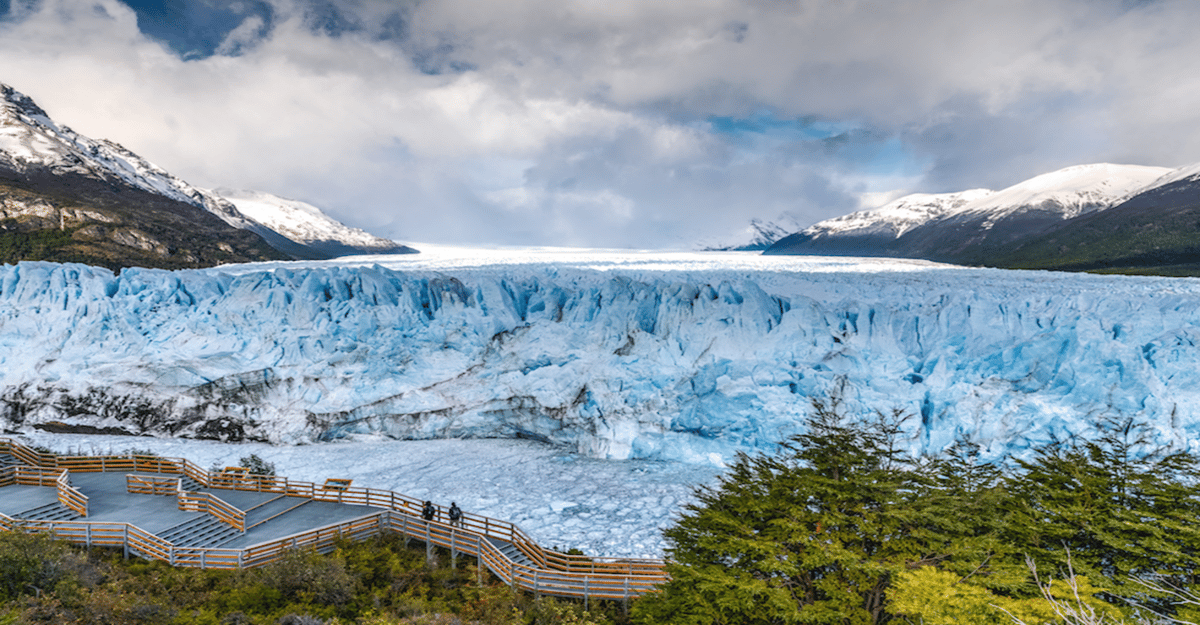 4 to 5 km wide
 Since 2019
Thinning
Near the tongue
- Before
- About 34 cm a year
- Now
- 5.5 to 6.5 m a year
- Retreat
- More than 800 m in places
Myth or fact
What you may have heard
Common claims about the glacier, checked against research.
No longer true
Researchers report thinning and retreat since 2019.1
It used to be stable
The front swung about 50 meters a year until recently.1
History now
The ice-dam ruptures came from periodic advances from 1940 onward.6
Not in that form
Models suggest more area loss, without a date.9
Far from it
It covers around 250 square kilometers.4
the Perito Moreno Glacier fluctuated back and forth by approximately 50 meters each year until recently. However, the situation has changed dramatically since 2019.
Why the change happened: the anchor beneath the ice
The research team mapped the ground beneath the glacier with a radar antenna mounted below a helicopter.10 They found something important: beneath the glacier tongue lies a subglacial bedrock ridge that acts like an anchor point.11 For decades that ridge helped hold the front in place, even as conditions changed, and it explains why the Perito Moreno behaved so differently from its neighbors.
As the ice thins, it becomes lighter, and the water of Lago Argentino gives it more buoyancy; the researchers explain that this causes more ice to break off and speeds up the retreat.12 The researchers' modeling suggests that the glacier, which has already lost about two square kilometers of area, could lose another 15 square kilometers.9 That is a projection based on recent trends, not a forecast with a date.
The researchers note that the ice may eventually find a new equilibrium further up the valley.13 Until then, the front visitors see from the walkways is likely to keep changing from season to season. Either way, the anchor explains both the famous stability of the past and the speed of the present change, and it makes the Perito Moreno a key place for glacier research. Reading the glacier as a system, not just a view, makes a visit richer.
Seeing it now
Make the most of your visit
01
Look for
- Calving at the front from the lower balconies
- Lines of rock and dirt in the ice
- Bare ground where ice once reached
02
Ask your guide
- How the front has changed in recent years
- Where the ice dam used to form
- How researchers measure the glacier
Calculator
See it with your own eyes
Compare a day at the walkways with a closer look from the water or the ice.
People
Total from$138
per guest from $69
Check availabilityfree cancellationGlacier tour prices start from what GetYourGuide lists; for other currencies we apply the ECB reference rate, and checkout confirms the final sum.
Video
The Future of Patagonia's Glaciers | Climate Change I ARTE Documentary
The video loads only when you tap play.
The size of the Perito Moreno glacier
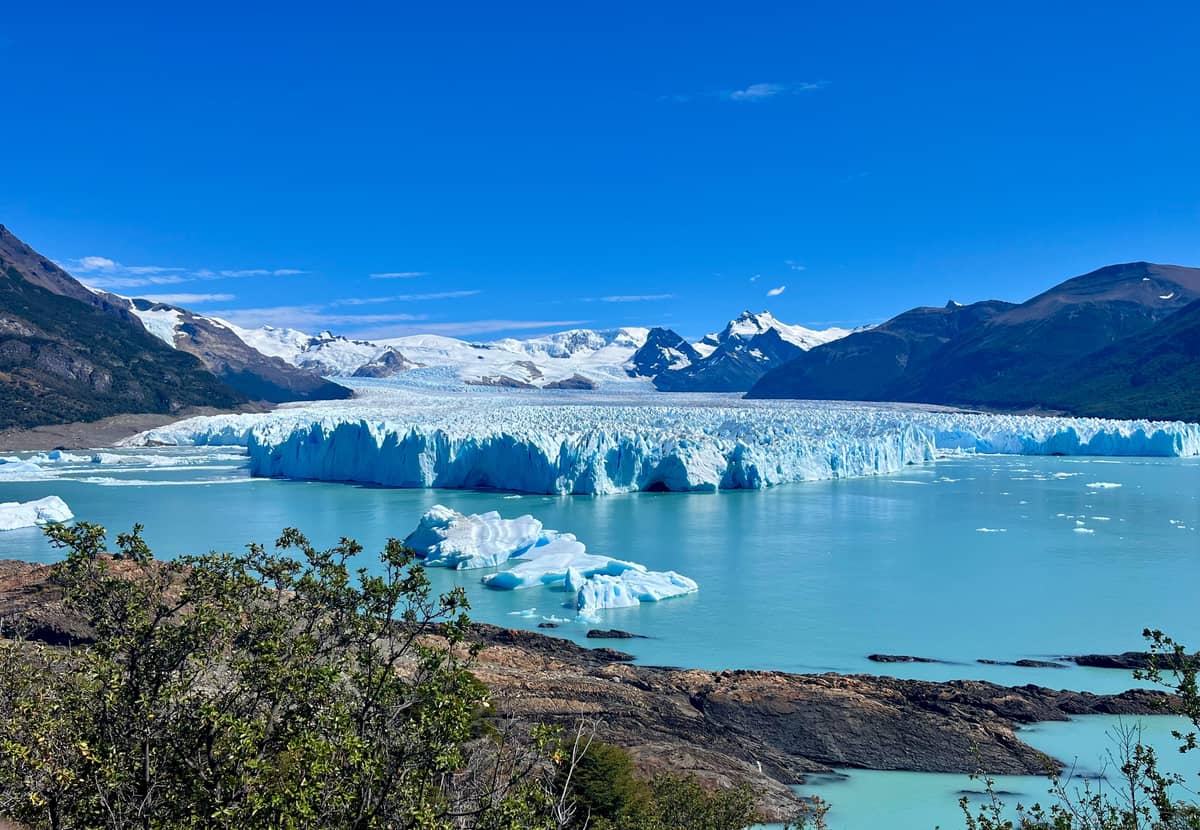
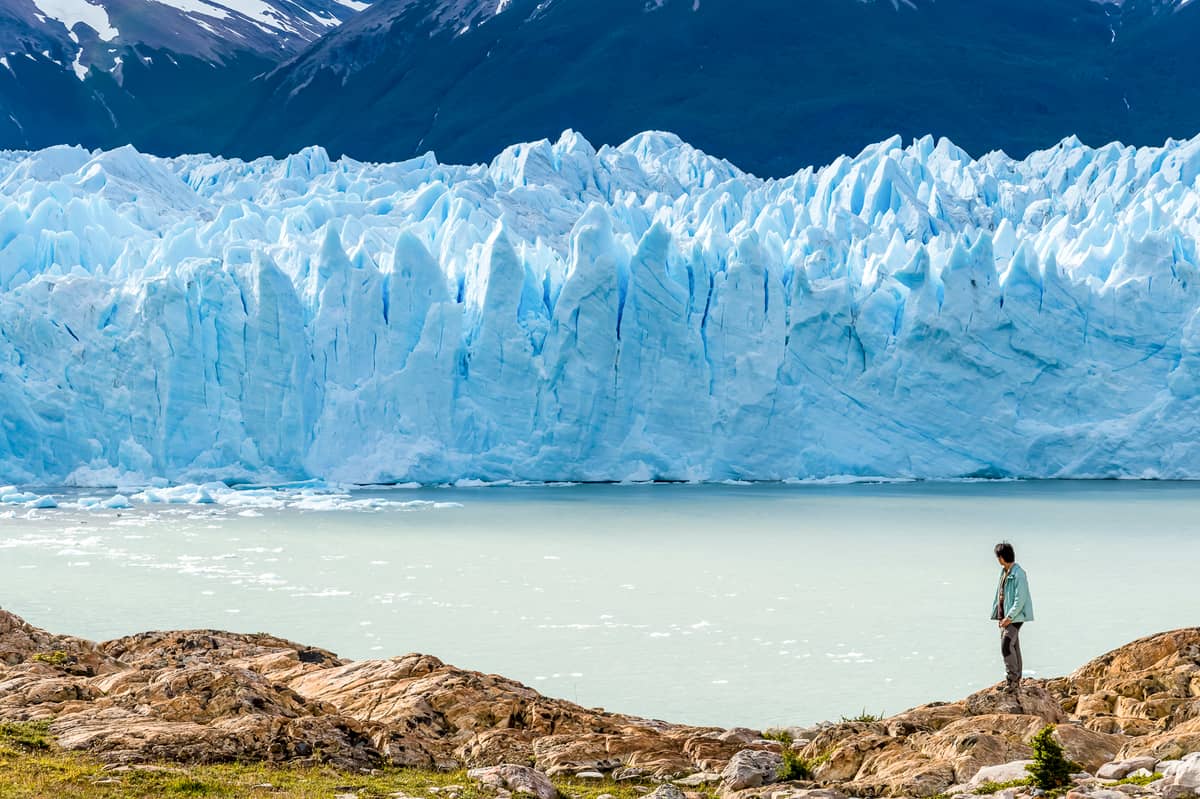
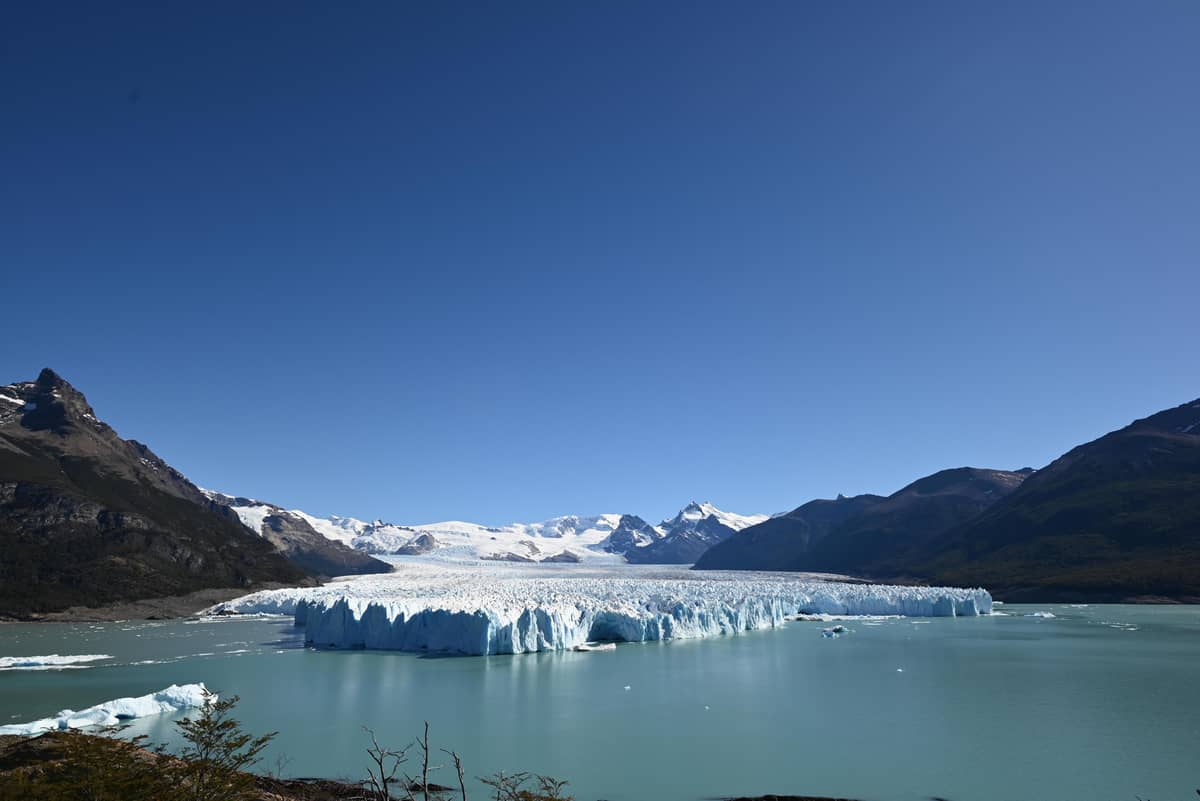
Even while shrinking, the size of the Perito Moreno glacier is hard to grasp. It covers around 250 square kilometers, roughly three times the area of the German city of Erlangen, as the researchers put it.4 The national parks administration gives its length as close to 30 km, with a front of 4 to 5 km on the southern arm of Lago Argentino.7 Numbers like these are easier to feel than to picture: stand on the lower balconies and let your eyes travel from one end of the front to the other.
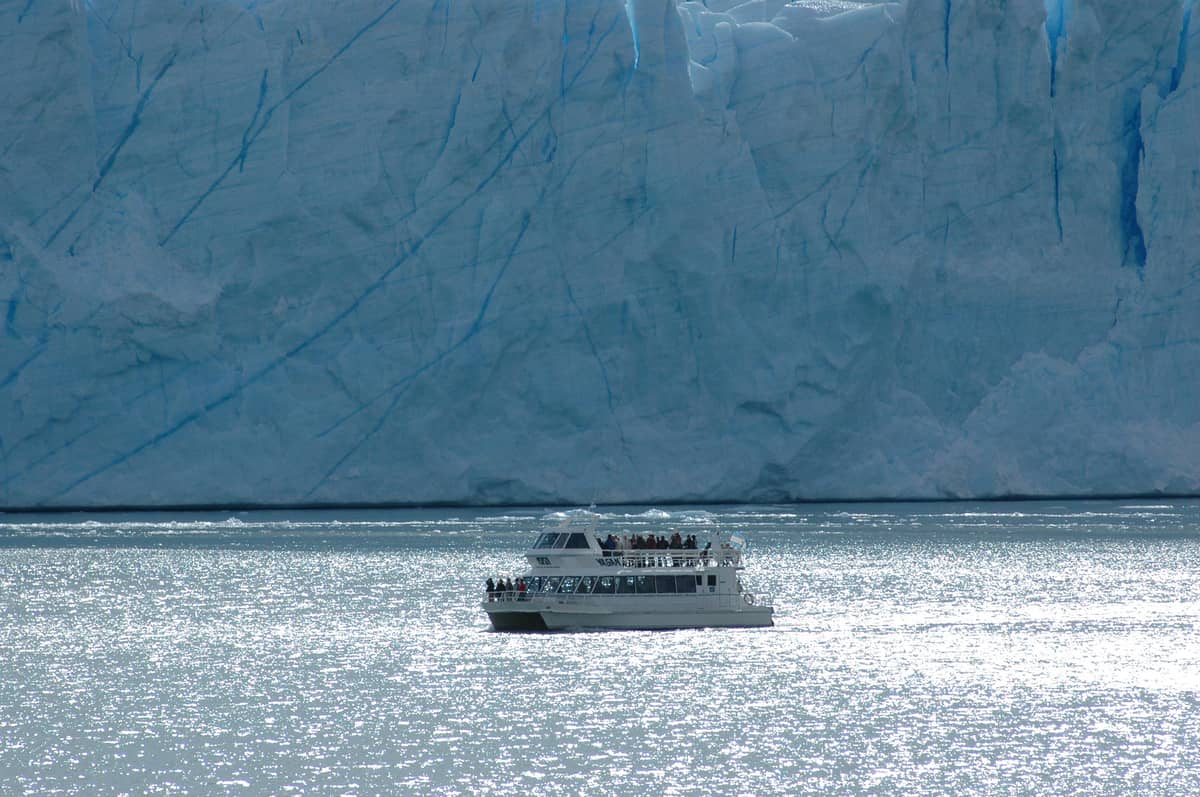
The front is also tall. Seen from the lake, it rises more than 60 meters above the water and runs more than 4 km from side to side.8 From the walkways, the height is hard to judge, since nothing next to the ice gives a sense of scale. Boats sailing close to the front provide the comparison: they look tiny against the wall, and the photographs taken from the water show the true size best.
The glacier is part of a far larger protected landscape. Los Glaciares National Park spans 726,927 hectares, more ground than any other national park in Argentina.1415 Argentina set it aside in 1937, and UNESCO added it to the World Heritage list in 1981.5 The Perito Moreno is the glacier visitors know best, but it is only one of many that flow down from the ice field into the park's lakes. Exploring a little beyond the walkways, for example on a cruise, shows just how much ice the park still holds.
The end of the famous ice-dam ruptures
Some of the most spectacular moments in the glacier's history came from its advances. From 1940 onward the glacier advanced periodically and blocked the Brazo Rico, a side arm of Lago Argentino.6 The water behind the ice dam rose by several meters until the pressure became too great, the dam broke and the water rushed into the main body of the lake.6 Those ruptures drew crowds and made headlines around the world.
The researchers who documented the recent thinning consider these events likely to be over for several decades.16 A glacier that is thinning and retreating no longer pushes across the narrow channel to close off the Brazo Rico. For visitors, this means the dramatic ice bridges and their collapse are now part of history rather than something to wait for, at least for the foreseeable future.
Calving at the front has not stopped. Blocks of ice still break away and crash into the lake throughout the day, and the sound carries across the walkways. Watching that happen remains one of the great pleasures of a visit. The difference is that the rare, enormous rupture of the ice dam is no longer part of the glacier's regular rhythm. Patience on the balconies is still rewarded, and every collapse is a small spectacle of its own.
Interesting facts about the Perito Moreno glacier
Here are some interesting facts about the Perito Moreno glacier that put a visit in perspective. Its area is around 250 square kilometers.4 Its front stretches 4 to 5 km along the southern arm of Lago Argentino.7 It sits inside the largest national park in Argentina, protected since 1937 and listed as World Heritage since 1981.155 And for decades it was famous for not retreating, before measurements after 2019 showed a sharp change.1
The way researchers study it is fascinating too. A radar antenna mounted below a helicopter measured the thickness of the ice and mapped the ground beneath it.10 That survey revealed the bedrock ridge that held the tongue in place.11 Work like this turns the Perito Moreno into a living laboratory for understanding glaciers in a warming climate, and every visitor on the walkways is looking at the subject of active research.
For travelers, the message is to see it now with open eyes. The glacier remains huge, accessible and spectacular, with walkways, boats and treks that bring you close to the ice. Knowing what the scientists have found adds depth to the experience: you are not just looking at a beautiful wall of ice, but at a glacier in the middle of a remarkable change. Bring good questions for your guide, and the glacier will answer many of them in its own way.
Book your day
The ice front is waiting at the end of the road.
Reserve today, pay later, and cancel free of charge until a day before your trip.


You ask,we answer.
Is the Perito Moreno glacier growing?
No. Researchers report thinning and retreat since 2019.1
How fast is it thinning?
5.5 to 6.5 meters a year near the tongue. That was the rate from 2019 to 2024, after 34 centimeters a year before.2
How much has it retreated?
More than 800 meters in places. The tongue has pulled back that far in some areas.3
How tall is the front?
More than 60 meters above the lake. The front also runs more than 4 km.8
Will there be more ice-dam ruptures?
Probably not for decades. The ruptures came from periodic advances, recorded from 1940 onward.6
Why was it stable for so long?
A bedrock ridge. A subglacial ridge beneath the tongue acted as an anchor.11
Sources
The sources for this guide
- 1Friedrich-Alexander-Universität Erlangen-NürnbergPerito Moreno Glacier is detaching from its anchor↩
- 2Friedrich-Alexander-Universität Erlangen-NürnbergPerito Moreno Glacier is detaching from its anchor↩
- 3Friedrich-Alexander-Universität Erlangen-NürnbergPerito Moreno Glacier is detaching from its anchor↩
- 4Friedrich-Alexander-Universität Erlangen-NürnbergPerito Moreno Glacier is detaching from its anchor↩
- 5Administración de Parques NacionalesParque Nacional Los Glaciares: ficha del área protegida↩
- 6Friedrich-Alexander-Universität Erlangen-NürnbergPerito Moreno Glacier is detaching from its anchor↩
- 7Administración de Parques NacionalesParque Nacional Los Glaciares: ficha del área protegida↩
- 8European Space AgencyThe ice wall as it extended↩
- 9Friedrich-Alexander-Universität Erlangen-NürnbergPerito Moreno Glacier is detaching from its anchor↩
- 10Friedrich-Alexander-Universität Erlangen-NürnbergPerito Moreno Glacier is detaching from its anchor↩
- 11Friedrich-Alexander-Universität Erlangen-NürnbergPerito Moreno Glacier is detaching from its anchor↩
- 12Friedrich-Alexander-Universität Erlangen-NürnbergPerito Moreno Glacier is detaching from its anchor↩
- 13Friedrich-Alexander-Universität Erlangen-NürnbergPerito Moreno Glacier is detaching from its anchor↩
- 14Administración de Parques NacionalesParque Nacional Los Glaciares: ficha del área protegida↩
- 15Administración de Parques NacionalesParque Nacional Los Glaciares: ficha del área protegida↩
- 16Friedrich-Alexander-Universität Erlangen-NürnbergPerito Moreno Glacier is detaching from its anchor↩
Keep reading